
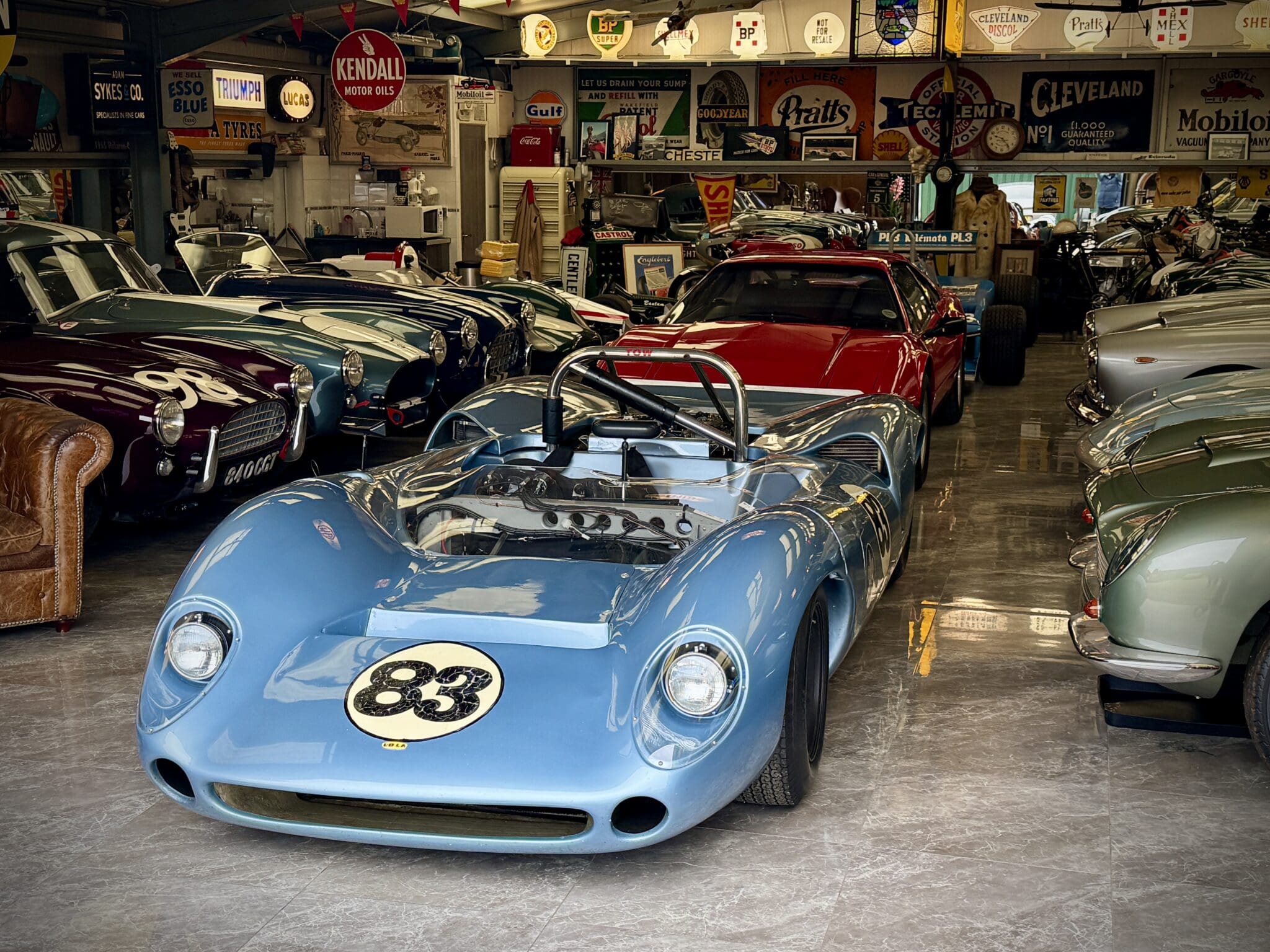
1966 Lola T70 Spyder Mk II – Chassis No. SL71/35
Few competition cars can claim a history quite as varied as this Lola T70 Mk II Spyder. Built in England in 1966, it was sold to one of America’s greatest racing drivers, was victorious in the Bahamas, and subsequently immortalised on film alongside Paul Newman – SL71/35 possesses a provenance that extends well beyond its relatively brief contemporary racing career. Today, presented in its familiar pale blue livery, it represents a fascinating chapter in the story of Lola, the Can-Am era and offers a golden ticket to some of the best historic races Worldwide.
The Lola T70:
Introduced in 1965, the Lola T70 established Eric Broadley’s company as one of the leading forces in international sports car competition. Designed for the emerging world of unlimited-capacity sports car racing, the T70 combined purposeful, low-slung bodywork with a lightweight competition chassis and the capacity to accommodate powerful American V8 engines. It was a formula particularly well suited to the Can-Am championship, where outright performance, engineering ingenuity and driver commitment were essential ingredients.
The Mk II represented an important stage in the T70’s early development, as British engineering increasingly met American power and racing ambition. With its wide stance, voluptuous bodywork and unmistakable open-cockpit profile, the T70 became one of the defining shapes of 1960s sports car racing. Its appeal today lies not simply in its striking appearance, but in its association with a period when specialist British constructors and American teams competed at the highest level with comparatively few restrictions on performance.
This car, Chassis SL71/35, was built by Lola Cars at Slough to Mk II specification and delivered on 5 July 1966 to John Mecom, the Houston-based Lola importer and agent. Finished in pale blue and initially offered without an engine, it was soon to embark on a career that would bring it into the orbit of an extraordinary cast of characters.
AJ Foyt and the 1966 season:
By September 1966, SL71/35 had passed into the hands of AJ Foyt Enterprises. Prepared by Mecom Racing, the car was fitted with a Ford Galaxie 427-cubic-inch V8 of approximately seven litres. The engine choice was an ambitious one. Mecom had already experimented with the big-block Ford in its own cars without the results hoped for, but Foyt was persuaded to give the combination its opportunity. Foyt, already an established force in American motor racing, was no stranger to formidable machinery. His subsequent achievements would include four Indianapolis 500 victories and victory at Le Mans in 1967 alongside Dan Gurney. Yet SL71/35’s initial outings proved frustrating. The car was entered for the Players 200 at St Jovite, Canada, on 11 September 1966, but engine installation problems prevented it from appearing. Its next opportunity came at the LA Times Grand Prix at Riverside on 30 October, a round of the Can-Am championship. This time the car made the start, but its engine lasted only seven laps before severe overheating forced retirement. The final chapter of Foyt’s brief campaign unfolded during Nassau Speed Week in the Bahamas in early December. The combination of a powerful engine and the rough, bumpy Oaks Field circuit presented a particular challenge. In the combined Governor’s Trophy and Nassau Tourist Trophy race on 2 December, Foyt retired early, preferring to preserve the car rather than risk further damage while the necessary development work remained unfinished. The following day, however, SL71/35 delivered its defining contemporary result. In the Nassau Classic, a four-lap sprint for cash, Foyt took the victory against expectations. It was a short race, but a significant one: the car’s sole recorded outright win under Foyt’s ownership. In the Nassau Trophy on 4 December, he finished 13th. Foyt never raced the Lola again. It returned to Mecom Racing, where it remained for approximately a year before being sold on. Although its period competition career had been brief, the association with Foyt had secured SL71/35 a place in the history of the T70 and in the story of one of America’s most celebrated drivers.
From the race track to Hollywood:
In February 1968, SL71/35 entered a very different environment when it became part of Bob Bondurant’s School of High Performance Driving at Orange County Raceway, California. Bondurant, an accomplished racing driver in his own right, used the Lola as a high-speed training car, introducing students to the demands of serious performance driving. Its most unusual assignment came when Universal Studios required racing machinery for Winning, the 1969 film starring Paul Newman and Robert Wagner. Both actors attended Bondurant’s school in preparation for their roles as racing drivers, and both received training in SL71/35. Newman reportedly demonstrated a natural aptitude for driving, while Wagner’s participation behind the wheel was more limited. In the film’s opening sequence, filmed at Road America, it was Bondurant himself who drove the Lola in the on-track action. The car can be seen in the sequence, lending the production the authenticity that only a genuine competition machine could provide. For SL71/35, this Hollywood appearance created a second identity. It was no longer simply the Lola raced by AJ Foyt; it was also a car associated with one of the most recognisable motor racing films of its era and with Newman’s growing interest in the sport. After filming, the Lola returned to Bondurant’s school and continued in training service for a number of years. Its working life there came to an end in the early 1980s, when Ford offered financial support to the school and provided a fleet of new cars.
Restoration and return to competition:
In the early 1980s, Lilo Beuzieron of Zicron Motors in Chatsworth, California is understood to have acquired a treasure trove of Lola parts, including the chassis bulkheads accepted as having come from SL71/35, together with the original chassis plate. Fast forward a couple of decades to 2006, Zicron Motors rebuilt SL71/35 using the aforementioned bulkheads and other acquired components. The completed car was then sold to Dutch historic racer Hans Hugenholtz, who returned it to competition in the historic racing arena. He campaigned the Lola at prominent historic events, including the Monterey Historics at Laguna Seca, the Goodwood Revival, the Grand Prix de l’Âge d’Or at Dijon and the Silverstone Classic. It was also displayed at the Techno Classica show in Essen. These appearances brought the car back into the company of significant historic sports racing machinery and introduced it to a new generation of enthusiasts.
Acquired by the current owner via Fiskens of Kensington in 2017, the car has been used sparingly since. Notable appearances included a 6th place finish at the Goodwoood Members Meeting, 2024. Fresh FIA papers were obtained by our vendor and this included fitment of side-draft carburettors, in place of the downdraft examples fitted when purchased. Maintained regardless of cost, the most recent run was at the Oulton Park Can Am reunion demonstration earlier this year.
Period competition record:
SL71/35’s recorded 1966 results are concise, but each entry tells part of the story of its early development.
11 September 1966 – Players 200, St Jovite, Can-Am: Did not arrive, following engine installation problems.
30 October 1966 – LA Times Grand Prix, Riverside, Can-Am: Retired after seven laps due to engine overheating.
2 December 1966 – Governor’s Trophy and Nassau Tourist Trophy: Retired.
3 December 1966 – Nassau Classic, Bahamas: First place in the four-lap sprint, driven by AJ Foyt.
4 December 1966 – Nassau Trophy, Bahamas: Finished 13th.
Conclusion:
AJ Foyt provenance: Sold to one of the great American racing drivers and campaigned by him during the 1966 Can-Am season.
A period race victory: Winner of the Nassau Classic four-lap sprint in December 1966.
A distinctive engine configuration: Originally fitted for Foyt with a Ford 427-cubic-inch, seven-litre V8. Now fitted with ultra-competitive Chevrolet ‘small block’.
Film history: Used in the preparation of Paul Newman and Robert Wagner for Winning, with Bob Bondurant driving the car in the film’s opening racing sequence.
A long second life: Used by Bondurant’s driving school before its reconstruction by Zicron Motors in 2006 and subsequent return to historic competition.
International historic racing credentials: Campaigned at events including Goodwood Revival / MM, Monterey, Dijon and Silverstone, with in-date FIA Historical Technical Passport.
Spares:
Full set of painted bodywork, lightweight set currently fitted
LG 600 Gearbox in useable condition
Various running spares
3 Spare wheels, with tyres
Available for viewing at our Cheshire showrooms by appointment only.
Please note – Interested parties should satisfy themselves with the description and condition of each vehicle. Each motorcar is offered ‘as is/as seen’ as per our terms and conditions of business. The history listed above is to the understanding of ourselves and the vendor, using the available resources. Any disputes will not be entertained after a sale has been agreed.